

French Drain Versus Swale Drainage: Which Works?

Updated: Sep 8
A wet strip along the foundation, a driveway that turns to ice every winter, or a backyard that stays soft for days after rain is not a problem to cover with more topsoil. Water is telling you something about the grade, soil, runoff path, or drainage system. When homeowners compare french drain versus swale drainage, the right answer depends on where the water starts, where it needs to go, and what is underneath the surface.
Both systems can solve real drainage problems. However, they can also fail when installed as a shortcut. A trench with a pipe will not fix water that has no legal or practical outlet. A shallow swale will not protect a foundation when groundwater builds pressure against the wall. The goal is not to install the most familiar option. It is to direct water away from structures and usable areas for the long term.
French Drain Versus Swale Drainage: The Basic Difference
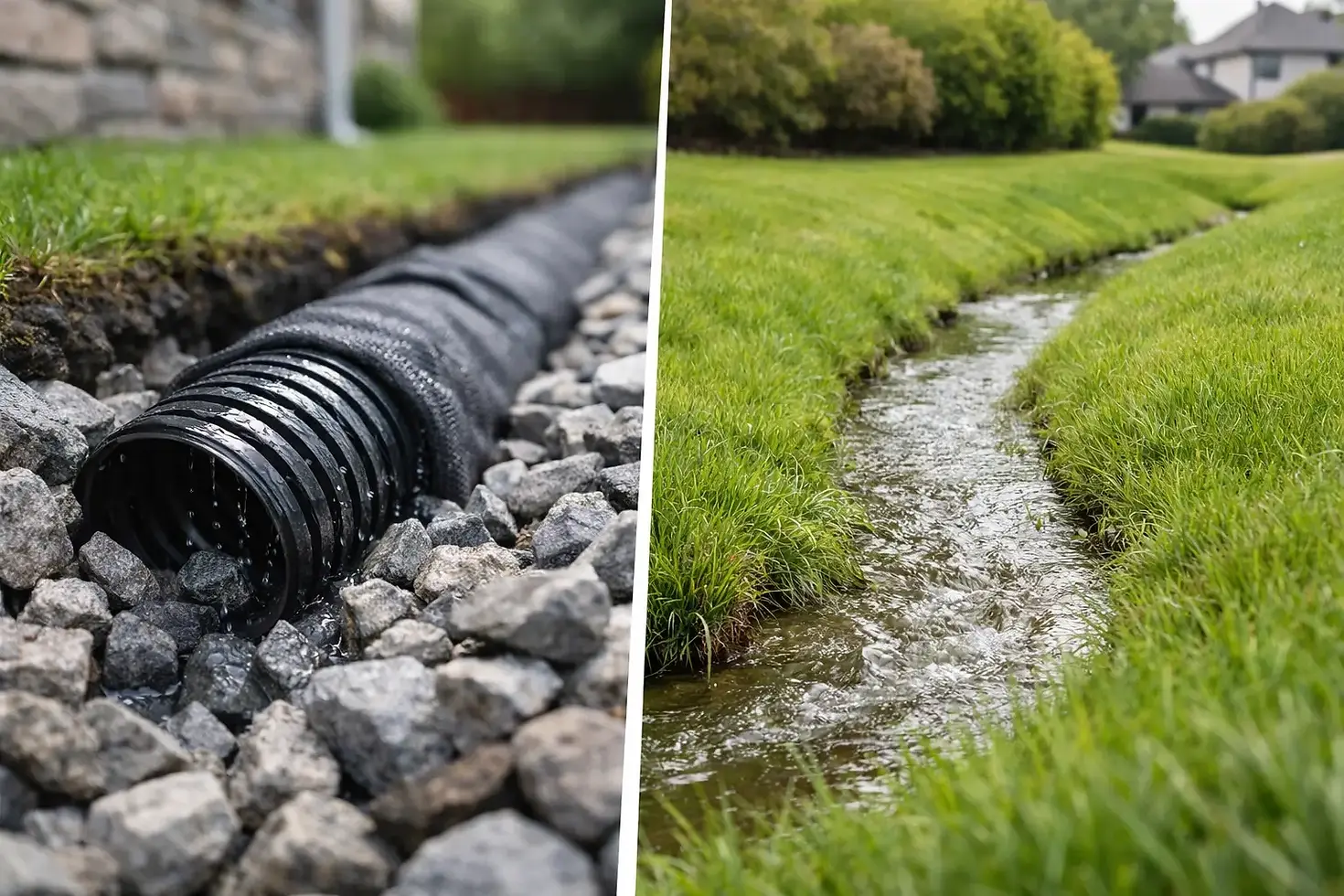
A French drain is an underground collection system. It typically uses a sloped trench, washed drainage stone, filter fabric, and perforated pipe to collect water moving through the soil and carry it to an approved discharge point. It is often used where water is below the surface, against a foundation, behind a retaining wall, beside a driveway, or in a persistently soggy area that cannot be corrected by grading alone.
A swale is a shaped channel at the surface. It is a broad, shallow depression that guides rainwater and snowmelt across the property without letting it rush uncontrolled toward a house, garage, driveway, or neighbor's yard. A properly built swale usually looks like part of the landscape, not an open ditch. It relies on positive grading, stable soil, and enough slope to move water at a controlled pace.
The simplest way to think about the difference is this: a French drain collects water underground, while a swale directs water over land. One is not automatically better than the other.
When a French Drain Is the Better Choice
French drains are commonly used when the drainage issue is close to a structure or occurring below grade. If water is getting into a basement, saturating soil near a foundation, or pooling along the edge of a driveway, surface grading may not be enough to solve the problem.
A foundation drain is a specific type of French drain installed at or near the footing. It helps relieve water pressure around the foundation and moves collected water away before it finds a crack, joint, or weak spot. This work often requires excavation, waterproofing evaluation, and careful backfill. It is not a place for shallow trenches, bargain pipe, or guessing at the outlet location.
French drains also make sense behind retaining walls. Water trapped behind a wall adds weight and pressure, especially during spring thaw and heavy rain. Without stone, drainage pipe, fabric, and a way out, even a well-built wall can shift, crack, or fail over time.
They can be effective in lawns as well, but only when the source of the wetness is understood. A low area may be wet because roof runoff is being dumped there, because compacted soil is holding water, or because the entire yard slopes toward that point. Installing pipe without addressing those conditions can leave the homeowner with a buried system that still does not perform.
What a French Drain Needs to Work
The pipe is only one part of the system. The trench needs a consistent slope. The stone must be clean enough to allow water through. Filter fabric should separate surrounding soil from the stone so fine material does not clog the system. Most importantly, the drain needs a real outlet, such as daylight at a safe lower elevation or another properly designed discharge solution.
In New Hampshire and Massachusetts, freeze-thaw cycles make good installation even more important. Water that cannot exit a pipe can freeze, back up, and create the same wet conditions the system was supposed to prevent. Drainage work must account for elevation, soil type, seasonal runoff, and the location of utilities, septic components, wells, and property lines.
When a Swale Is the Better Choice
A swale is often the smarter and more cost-effective choice when the issue is surface runoff. For example, if a backyard slopes toward the house, the first correction may be to regrade the yard so water flows around the home and toward a suitable low point. A well-shaped swale can intercept that runoff before it reaches the foundation.
Swales work particularly well across larger open areas, along the uphill side of a home, or beside a driveway where rainwater needs a defined route. They can also reduce erosion by slowing and spreading runoff instead of concentrating it into a narrow channel.
The word "swale" sometimes makes homeowners picture a deep ditch across the lawn. That is not the goal. Most residential swales are gradual and mowable. They should be noticeable enough to carry water, but not so abrupt that they create a tripping hazard, interfere with lawn use, or make the property look unfinished.
A swale is not the right fix for every wet yard. It does not address water pressure at a foundation wall, and it will not pull water out of saturated soil the way a properly designed subsurface system can. If a swale has nowhere to send the runoff, it simply moves the puddle from one part of the property to another.
Cost, Appearance, and Maintenance Trade-Offs
Swales are often less expensive than French drains because they usually require less excavation, fewer materials, and no buried pipe. If grading can solve the problem, that is often the most direct solution. It also makes future maintenance simple: keep the channel clear, maintain grass or erosion control, and make sure landscaping changes do not block the flow path.
A French drain generally costs more because the work involves excavation, stone, pipe, fabric, connections, and restoration of the lawn, pavement, or hardscape above it. Access can also affect pricing. A drain beside an open lawn is different from one that requires removing a walkway, excavating near a foundation, or working around utilities.
Appearance is another practical consideration. A swale remains visible, even when it blends into the lawn. A French drain is hidden after restoration, which can be a benefit around patios, walkways, and landscaped areas. However, hidden does not mean maintenance-free. Outlets should remain open, downspout connections should be checked, and surface grading should not be changed in a way that sends water away from the collection area.
The Best Drainage Plans Often Use Both
Many properties need more than one drainage measure. A common solution is to regrade the surface with a swale to intercept uphill runoff, then use a French drain where water collects near a foundation or retaining wall. Downspouts may need extensions or solid pipe to carry roof water beyond the problem area. A driveway may need a trench drain, culvert, or improved edge grading to keep runoff from washing out the base.
This is where failed drainage work usually starts: someone installs one component without looking at the whole property. They bury perforated pipe too close to the surface, run it flat, wrap it in the wrong material, or discharge it where water returns to the house. The system may look fine when the job is complete, then fail during the first hard rain or spring thaw.
Before choosing a solution, look at the property during or shortly after rainfall. Note where water enters, where it ponds, and where it naturally wants to leave. Check roof runoff, driveway pitch, foundation elevations, existing drains, and any changes made during past landscaping or construction. If the problem involves a basement, retaining wall, septic area, or major grading change, a site evaluation is worth far more than a quick trench.
Water problems rarely improve by waiting. They usually show up again as washed-out soil, cracked pavement, wet basements, damaged landscaping, or ice where people walk and drive. The right drainage system is the one that gives water a dependable path away from the places you need to protect, built with the slope, materials, and workmanship to keep doing its job year after year.
Conclusion
In conclusion, understanding the differences between French drains and swale drainage is crucial for effective water management around your property. Each system has its strengths and weaknesses, and the best approach often involves a combination of both. By carefully assessing your specific drainage needs and considering the unique characteristics of your property, you can make an informed decision that protects your home and landscape for years to come. Remember, addressing water issues promptly can save you from costly repairs down the line!


Comments